Tuesday, April 15, 2014

The Story About That Rock

 In the previous post, I included a picture of a rock that's out in the pasture.  It's the sort of rock that you could plop down in your zen garden, stare at it all day from different angles, different times of the day, and different times of the year while pondering the meaning of life.  It's covered in moss and has eroded from the wind and rain into interesting patterns, little pockmarks cover one side and horizontal layers show on the other side.   It has probably sat in this same position since before it became a rock.


But, if I'm walking around this pasture looking for a cow during calving season and just happen to look at it  from the right angle it looks exactly like a dead, bloated cow.  And, it continues to look like a dead cow until you get a little closer to it.  Every time it fools me, I grit my teeth and start thinking about getting the bulldozer and bulldozing the heck out of it.  


Then, I remember that it's a cool looking rock that has been out there forever and will still be out there getting more and more interesting looking for a long time after I'm long gone, and if anyone else is looking for their cattle in that pasture in the future their hearts will also skip a beat when they look at that rock from the wrong angle.  

So, that rock gets a stay of execution until the next time it fools me, when I swear at it for a while and start thinking about bulldozing it into oblivion.

All that probably has something to do with the cycle of life, the duality of man, or some other highfalutin philosophical meaning, but all I know is that that rock is both worth protecting and irritates me to no end at times.

Monday, April 14, 2014

What the Heck?!, It's Snowing in April!?

Yesterday afternoon it was hot, dry, and windy with temperatures in the 80's, and the weather forecast was for a cold front to come in Sunday evening, with low temperatures today in the 30's, a frost warning, and the possibility of some light snow.

I didn't see any frost this morning, but it was cold with a wind blowing out of the north.  It didn't matter if it was hot, cold, wet, or dry, I had a couple of cows that had either calved or were getting ready to calve yesterday, so I had to go hunt them up this morning to check on their calves.  Almost as soon as I started walking, the wind started howling out of the north and it started snowing, which made it pretty easy to find those cows and calves since there's only a handful of spots in that pasture that are down out of the wind.

Most of my cows seem to have enough sense to hightail it to these spots when it gets cold and windy, and one of them was down there with her day-old bull calf, while the other cow was over in some brush with her calf (she's a little camera shy, so no picture of her or her calf).
Cow and Calf Hunkering Down Out of the Wind
While trying to get a few pictures of the snow blowing almost horizontal, I gained a little respect for people that make a living with their cameras.
Interesting Looking Rock out in the Pasture

Same Interesting Rock

Cattle in the Blowing Snow
I can't remember the last time I've seen it snow in April, but the forecast for tomorrow is for a low temperature somewhere in the low 30's or high 20's.  I'm just glad the wheat is a little behind schedule or there would be a very real possibility of freeze damage, but there's nothing I can do about it, so I try not to worry about it too much (easier said than done).

I feel sorry for those that work in climate-controlled offices that don't get to experience the simple pleasures of walking around looking for day-old calves when it's hot, dry, wet, or cold.

Thursday, April 10, 2014

If I had a Little Bulldozer, I Could Move a Little Mountain

One of my favorite tools on the farm is this little bulldozer, it's over 40 years old (EDIT:  somehow I did the math wrong in my head, and it's actually just under 30 years old so it's still almost a youngster), can be cantankerous at times, and is almost completely worn out, but it's a blast to dig with it. 
Believe it or not, this bulldozer was bought on eBay about 7 years ago, shipped to OK from the East Coast, driven off of the trailer, and went to work around the farm.   I've fixed the spillways on three ponds, got it buried in the mud twice (make sure you have a bigger tractor with a big chain if you want to try that), cleared out a few miles of fenceline with it, cleaned up two old oil well sites, and fixed all the terraces on the farm.

Today, I should have been finishing up clearing out that lane (holy cow, I never would have guessed that trees could grow that much in 12-13 years),  but after cutting a pickup load of firewood along with another pile of future bio char, I got distracted by an overwhelming urge to jump on the bulldozer and fix a spot of erosion that has been calling out to be fixed.  

A tornado came though this area about 14 years ago, knocking down a lot of trees and tearing up all the fences.  In this area, the tornado damage was bad enough that a bulldozer was hired to cleanup the fence line (that was before "little bulldozer" had made the trip from the East Coast to the farm), then a few months later, the remaining tornado debris was cleaned up during a tornado cleanup program with a team of bulldozers, trackhoes, and front loaders.  All that equipment got the debris cleaned up in a hurry, but also removed a lot of topsoil, and left some ruts, etc.  

Over the years, this hillside started to have some erosion problems, so I decided to start fixing it.  

I first started along a fence line that runs up a hill.  To get an idea of the slope of the hillside, if you look at the picture you can see the corner posts which has the horizontal brace post installed almost level.

Starting up the Hill, note the Brace Post


Partway up the Hill
While I was smoothing out the ruts along that fence line, I went ahead and fixed the erosion of the entire hillside.  There happened to be some bermuda grass growing in spots, so driving the bulldozer back and forth should have planted enough bermuda to stabilize this hill when it starts growing, but I'll haul a few bales of crabgrass hay to this spot and use the cattle to make sure that I get some grass growing here as quick as possible.
King of the Mountain
Most of the soil around here is some sort of red color, but it really looks red in these pictures.

This little bulldozer cost a little bit more than a new ATV would have cost, but I don't think I could move this much dirt with a ATV or have as much fun running over stuff.   Every time someone comes out to the farm, I always ask them if they want to try driving my bulldozer around a while and I'm always surprised how few take me up on the offer, which usually puzzles me.  

The way I see it, if someone ever offers to let you drive their bulldozer (even if it is old and worn out) take the opportunity. 


Monday, April 7, 2014

The Original Proof of Concept Prototype Version of My TLUD

I drug my little TLUD out the other day, so I could make as much biochar at a time as possible (since most of the work is just standing there watching the TLUD, I might as well use both of them).  Since I'm also on a mission to get more people making biochar and experimenting with it, I thought it might be worthwhile to write a little bit about this little TLUD.

When I was first trying to figure out how to build a simple TLUD, I used a little 16 gallon barrel I had that had a rusted out bottom and wasn't really good for anything else besides building an experimental TLUD.  Standing next to a 55 gal. barrel, it looks pretty small.
It was rusted out enough that I first started out by using a ball peen hammer to hammer about 8 holes around the perimeter.  When I first tried to make bio-char with only the big holes around the outside, it smoked like a locomotive, and didn't really work as a bio-char making machine.  So, on my second try, I punched some more holes in the center with a punch, and it seemed like that gave me enough air flow to actually work like a TLUD is supposed to work.
I only had one lid for this barrel, so I used an old satellite dish that I had for my chimney lid (it was bigger than the barrel and had a nice domed shape to it, so that's what I used).  Using a grinder with a cutoff wheel, I cut eight slots in the center and bent them up so I could attach my chimney.  Just like the 55 gal. version, I wrote about before, I cut past the 8" mark to leave little slots at the base of the chimney to help feed the "afterburner" fire in the chimney.

For my chimney, I had part of an old chicken feeder that was missing the bottom part, it's about 8" in diameter, and might have been a little big for this barrel, but I used what I had.  With a chimney that's proportionally bigger in diameter and a little shorter, the flames will come out of the top of the chimney (which might be pretty cool to watch at night).

When this chimney was a chicken feeder, it had a rod running the length of it that went through this crosspiece, which I left to use as a handle to move it off and on the barrel with something like a pitchfork, a long stick, or something similar.

From this point on, the little TLUD is used in the same way as the big TLUD, and I thought I had some pictures of some dueling TLUDs during the burning process, but apparently the camera decided it would be overkill to show that many pictures. 

So, try to imagine that these two TLUDs are lit on fire, the chimneys are put on and the flames shoot out of the top of the chimney of the little one, while the big one is a little more bashful about showing any flames and usually doesn't.   In about 45 minutes to a hour, it's time to take the chimneys off, carefully remove the sticks under the barrels, and smother the fire by putting the lids on (throw a little dirt around the bottom edge of the barrel and chunk something on top of the lid to make double sure it's airtight).
I hope this encourages anyone reading this to try making their own version out of whatever they have laying around, even though it's technically a type of rocket stove, it ain't rocket surgery.

Sunday, April 6, 2014

Watching Grass Grow


I figured that everybody was probably sitting on the edges of their seats, or pacing back and forth in anticipation waiting for an update on how my wheat was growing, so I decided to go out and take some pictures so nobody would have to explain why they wore a groove in their floor with a bunch of apprehensive pacing. 

Just to jog my memory, here's a picture taken about two weeks ago.

23 March 2014

 Even though it's only rained a little less than 2" since last October, and we got a gullywasher of a rain that totaled about 0.10" (that's a tenth of an inch) soon after that first picture, I think the wheat looks pretty good so far.  I changed my landmark stake but it's in the same spot, it's impossible to tell, but the wheat is about 6" tall at this point.
6 April 2014
 While I was taking pictures, I also took a picture of a garden/test spot where I've spread bio char for a couple of years, along with a thick compost application about 4 years ago and some fertilizer a couple of times. 
Wheat in Bio Char - 6 April 2014
If I was running some sort of official trial on bio char, what little data I have would be thrown out, but my unofficial assessment is that I'm seeing some significant results from the bio char in this small test.  The wheat is almost 10" tall in this spot, and has only had a little 18-46-0 fertilizer applied this spring compared to the field that had 90 lb of nitrogen applied this year. 

For what its worth, this spot has also been sprayed with glyphosate to control weeds and bermuda grass a few times over the years.

About 5 years ago, I planted about 2 acres of conventional canola to see if I could figure out how to grow the stuff, and quickly learned that conventional canola is almost impossible to grow around here and there is a reason they came out with RoundupReady canola.  Even though some steers ended up grazing that field of canola and I was hesitant to try growing it again, I had a little seed left from that experiment and I have been using it little by little as a cover crop in my gardens.  In the garden, it's a relatively easy crop to grow, and in the spring all those yellow blooms are out there with their siren calls trying to tempt me into trying once again to grow it on a larger scale.

This year, we had an early freeze (mid-October?) which killed a lot of canola, then we had a lot of days with single digit lows that killed most of the surviving plants.  To remind me why I hadn't tried to grow it again, I took a picture of my entire "crop" of canola in the garden.   I'm glad I didn't plant an entire field of canola last fall.
My Entire Canola "Crop"

Friday, April 4, 2014

Quail, Cows, and Bio-Char

A few years ago, I built an electric fence along the edge of the wheat field to make a lane in between two pastures so that I could easily move cattle back and forth at any time of the year.  Originally, I was just interested in the "easy way to move cattle back and forth" aspects of building the lane, but it's turned into a combination wildlife strip, grazing paddock, and easy way to move cattle.  

When I was a kid, there used to be more bobwhite quail around (or at least it seemed like there were more quail), and I've noticed that quail have started to show up in this lane for some reason.  I think it's a combination of being close to the trees on one side and the wheat field on the other, along with the areas of shorter grass in the lane due to how it's being grazed and brush hogged once in a while.  Edges create the right habitat for quail, and trimming the trees back from the fence should give me more depth to my edges and help create more depth.

I'd like to graze the lane a little differently by letting the cattle graze it in a modified "strip grazing" method where I'll move an a electric wire down the length of it a little at a time to get the stocking density up higher.  In the future, I'd like to implement a more intense grazing rotation on the farm (some sort of MiG grazing, or mob grazing), and this would be a good place to test and work out some details.  But, to do that I also need to clear out the brush and trees on the barb wire fence side so I can easily add another hot wire to that fence.

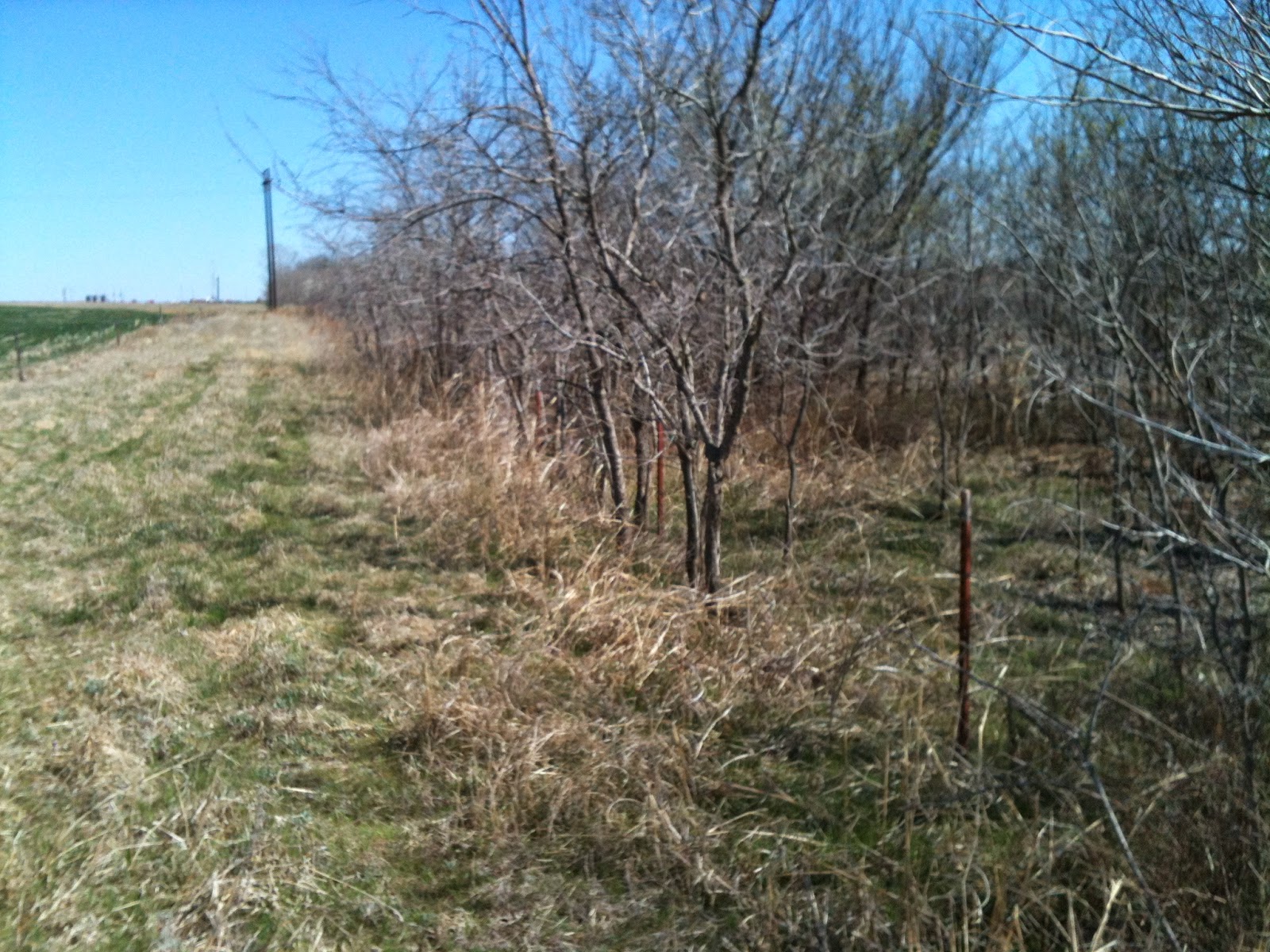
So, today I started trimming the trees and brush out of the original barb wire fence, starting on the south end of the lane.  For once, I lucked out and found myself cutting brush on a day when there wasn't 100% humidity and the temperature wasn't over 100 degrees.  If you look close, you can see some gate posts with a gate buried in that brush.
Before trimming - Brush-covered Gate

Another Before Trimming Picture
 It's amazing how quick the cutting goes when I'm not drowning in sweat, on the verge of heat stroke,  and don't have to fight my way through a bunch of leaves on the trees.   Since I planned on making bio-char out of some of these trees, I could just lop off the small limbs, then cut the bigger stuff into lengths and pile them up. 

If you look close you can even sort of see the gate posts and gate that were being strangled by those trees. I didn't get the exact same angle in the second picture, but if you really squint your eyes you can tell it's the same spot.   

You can already start to see the improved quail habitat after the trimming with the wheat, short grass, tall Johnson grass, then the trees, leaving plenty of places to eat, nest, and get away from predators.
  
After Trimming
 As soon as I had enough wood cut to fill up the pickup, it was quitting time. After all, I didn't want to trim the entire lane today because then I'd have to figure out something else to do tomorrow.

Pile of Wood that's eventually going to be Bio Char
Tomorrow, I'll start on the north end of the lane, and if I'd been about 30 seconds faster with the camera you would have seen the quail I kicked up right before I took this picture.  Just close your eyes and imagine them running towards the trees and then BAWPPHTTT flying up and over the fence.

North End of Lane - Looking South
It's not often that I accomplish three different things in one period of working, improving the habitat for my wildlife, making it easier to test out some grazing ideas, and getting some material to make more bio-char..  Plus, I got to see some quail as a bonus.

Tuesday, April 1, 2014

Counting Hay Bales When the Sun Isn't Shining


I went out today to count how many bales of hay I had left after feeding the cattle this winter and ended up with 137 bales of hay.

Even though it was relatively wet last year (although it stopped raining around May), we've had drought conditions for about the last six years or so.

The summer of 2011 was supposedly worse than the droughts in the '30's, almost every day during the summer was over 100 degrees, the ponds were as low as I'd ever seen them, I was only able to bale about 60 bales of hay to add to the 60 bales I had left from the previous year,  and I almost didn't plant any wheat that fall because it was so dry I didn't think I could get the drill in the ground.  

It finally rained enough in late-October so that I could plant the wheat.  Then it rained even more, all of the ponds filled up to overflowing, and all of the wheat came up.  By rationing what hay I had and grazing a failed grain sorghum crop I somehow managed to make it until early-March before I ran out of hay.

Luckily, we got enough rain in April to get the grass growing and also give me a decent wheat crop. Enough rain fell by late-spring of 2012 that the drought was "officially" over.  

I wanted to believe that the drought was over, but I had a gut feeling that it wasn't. So, I baled the straw off of a 40 acre wheat field as insurance and then drilled in some sorghum-sudangrass. There was enough moisture in the ground for that sorghum-sudangrass to germinate and grow about 10-12" tall, then it just stopped growing because it stopped raining and the temperatures climbed.  

By the end of the summer of 2012, the drought that summer was being called the worst in recorded history, the ponds were lower than they had been the previous year (one dried up completely), the grass hadn't really grown all summer, I was thinking about selling a bunch of the cows after weaning their calves, I had another failed grain sorghum crop, and I only had about 50 bales of hay plus those 100 bales of wheat straw to feed the cattle over the winter.  The only thing that gave me much hope was that I had been no-tilling for a few years and was starting to see the benefits from it because there seemed to be enough moisture to get the drill into the ground so I could plant some wheat.

I didn't think there was any chance that I would be lucky enough for it to rain at the last minute like it had a year before,  but it finally rained in September (I didn't realize how stressed I actually was until I stood out in that rain and felt like the weight of the world had been lifted off of my shoulders). 

After it rained, the field of sorghum-sudangrass started growing again and I was cutting and baling it about 3 weeks later.  That failed grain sorghum crop did the same thing and I was able to salvage it by baling it too.  

That rain in September gave me enough extra hay to last until mid-April (I fed later into spring to give those drought-stressed pastures a chance to recover). 

By 2013, it had rained enough to have the drought declared over once again and my gut told me that it might actually be true this time.  But, I took advantage of the extra moisture and put up as much hay as I could,  40 acres of prairie hay, 60 acres of double-dropped crabgrass hay, and 40 acres of double-cropped sorghum-sudangrass.  Even though I had more than enough hay, I rationed it out like I had a limited amount of hay, and grazed a field of grain sorghum stubble before I started feeding any hay. 

Because of all that, on the first day of every month for the last three years, I've carefully counted how many bales of hay I had left, so I know where I've been and how much farther I can go. 

Fighting my way through those droughts showed me that I need to gamble on things more often (planting wheat and sorghum when the chances of success looked almost impossible, etc.), never give up (it will eventually rain, etc.), and I needed to have more confidence in whatever I'm doing (no-tilling saved my wheat crop a few times,etc.).  And, that change in mindset might be more important off the farm than it is on the farm.

Who would have thought that counting bales of hay could mean that much?