Monday, August 24, 2015

Double Crop Soybeans - August 23


The better part of my soybeans, I'm not gonna show the bad parts

There's actually some pods on the plants

Marestail in the soybeans

Back on June 25 after I'd finished harvesting the wheat, I planted about four acres of soybeans as a small test to see if it was possible to double-crop soybeans around here.  There's nothing really interesting or a whole lot to write about a little test plot of soybeans, but I'll write about them anyway so I'll better remember how they grew.

To my inexperienced eye,  they seem to be growing okay, sort of so-so, not bad but they could be better. Right now (August 23) about 60 days after I planted them they are about 18-20 inches tall and seem to be growing taller and wider every day.  They are far from completely canopying and filling in the rows, but that might be partly because they're planted on 30 inch rows.  They're flowering and setting pods. 

Since I have almost no firsthand experience with growing soybeans, I'm not sure if any of that is good or bad, or ahead or behind of schedule.  It's been a while since I haven't been exactly sure about what I'm looking at and whether I should be satisfied or disappointed with my efforts, but right now I think they are growing halfway decently, they could probably be better, but I don't really know for sure.

One thing I have figured out is that weed control is pretty important when growing soybeans.  I knew I was going to have problems with marestail, and I purposely planted my test plot in this part of the field because it has had some problems with marestail in the past and I wanted to see how big of a problem it would be when growing soybeans.  I quickly reached the conclusion that I definitely don't want any marestail in my soybeans, and that paying close attention to marestail control will be one of the most important parts of growing soybeans.

In the future, getting rid of marestail will be better done before planting soybeans, but I reached the point where I couldn't stand all that marestail out in my soybeans anymore, so I've been walking the field trying to get rid of all the  marestail off and on for about a week or so.  I'm not done with my weed control yet, but I'm closer to being finished than I was when I started. Walking four acres to control weeds is barely doable, but a hundred acres seems like it would be almost a herculean task.

I was expecting to see a significant amount of deer damage especially since this is the only soybeans for miles around, but so far I haven't seen much damage at all which is a little surprising.  It might be due to the wetter summer we've had, the grain sorghum field might be more attractive, or they might show up later in the fall, otherwise I'd think there would be more deer activity in the soybeans.

Stay tuned for action-packed updates about harvesting soybeans this fall, or how I feel like shooting a bunch of deer because they wiped out my soybean field before I could even harvest it, or some combination of harvesting soybeans and deer shooting.      

Tuesday, August 18, 2015

Hay Baling Battles


Finally done with this field of hay
It's been an exhausting week or so baling about 65 acres of crabgrass hay and I've never been so glad to be finished with a field of hay as this one.  There's been breakdown after breakdown, starting with the A/C in the tractor refusing to work which we fixed by taking the doors off of the tractor so that I wouldn't get heat-stroke.

Then, the disc mower pulled the three-point apart, so we "borrowed" the part needed to fix it from the other tractor. Sometimes it's handy to have two half-worn out tractors so that you can keep one running, other times I wonder if two half-worn out tractors are about as useful as one completely worn out tractor.
Tractor split apart, waiting on clutch parts

Soon after I started to bale the first half of the field, the throwout bearing and clutch in the tractor blew apart, which meant that we had to take the duals off of the other tractor so it could be used to bale the rest of the field.  For some reason, I must of really been worried about the lug bolts coming loose the last time I put those duals on the tractor because it took almost all I had to break them loose (alternating between jumping up and down, and hanging off the end on a long piece of pipe I was using as a cheater).

The stupid A/C in that tractor refuses to do its job just like A/C in the other tractor, so the doors also had to be taken off so that I wouldn't pass out from the heat, fall out of the open door, and get baled up into a bale of hay.    

I finally finished up baling the first half of the field, and was getting ready to start cutting the second half when I noticed a low tire on one side of the tractor so I put some air in it and kept an eye on it during the day.  The next day when I was getting ready to rake hay, the tire was even lower and now the other side was also low, which was a little concerning because I needed to get this hay baled.   All you can do at this point is air the tires up and hope you can rake fast enough to get done before you run out of air, which is what I did.  Just make sure that you stop once in a while while raking to check your tire pressure so you can make a quick run back to the compressor in time to avoid a flatter than flat tire in the middle of a field. 

By some stroke of luck, the tire held enough air long enough for me to get the hay raked, but the next day it was low again and the other tire was flat. What are the odds of that happening?  After airing both tires up, and driving slowly back and forth looking for something obvious stuck in the tire, nothing was found except that one tire was losing air faster than it could put it in. The consensus of everyone standing around looking at two flat tractor tires is that cheap tubes that have failed in some way might be the reason for all this trouble (there's no way to know until I get around to fixing both tires).
At this point, I had about thirty acres of hay left to bale, one flat tire, one tire that sort of held air, rain in the weather forecast the next day, not enough time to find a tube to fix this tire, and absolutely no desire at all to call someone to come out and fix the tire for me (it gives me the heebie-jeebies just thinking about paying someone to do something that I can do myself).

Since desperate times call for desperate measures, after a little "woe-is-me", expressing my displeasure with the unfairness of it all, and arguing back and forth, it was decided that the solution was to put one of the duals back on side with the flat tire and air up the other tire so that I could at least try to bale the rest of the hay.  The only bright spot in the whole crazy business of driving a lopsided half-dualed tractor around baling hay is that I was far enough away from the road that hopefully nobody had the chance to wonder why the heck I only had duals on one side of the tractor.

Surprisingly, I was able to get all thirty acres baled in almost record time, then was able to get the tractor back to the barn right before the "better" low tire also went completely flat (which makes me think even more that it might be something to do with the tubes disintegrating somehow rather than a more typical puncture type of flat tire).

As soon as all the parts get here, we can start putting one tractor back together, can get both tires on the other tire back to where they will hold air, and I can start getting ready to bale about forty acres of sorghum-sudangrass which I'm hoping isn't also going to be a knockdown drag out fight.

Wish me luck, sometimes I need it.

Tuesday, August 4, 2015

Grain Sorghum Update Along With Some Cover Cropping Problems and Thoughts

I had high hopes for the grain sorghum I planted back in late-April, I had a lot of crop residue on the soil surface from grazing the cover crop of sorghum-sudangrass I'd planted last summer, I finally had the weeds controlled, there should have been more than enough fertility to get some decent yields, the planter was setup almost perfect, and I had good soil conditions at planting.

Then it started raining and raining and raining.  The combination of a lot of overcast days, cooler than usual temperatures in May, and all that extra moisture seems to have really impacted my field of grain sorghum more than I thought it would have.  All those conditions made everything grow much slower than normal, root systems weren't developed as deep as they should have been, and I'm guessing that I lost a significant amount of nitrogen.
Grain sorghum starting to dry down with way too many volunteer sorghum "weeds"
 
The major problem I have is a bunch of volunteer sorghum-sudangrass coming up all over the field.     Sorghum-sudangrass is a hybrid which means it really isn't supposed to produce viable seed, so I probably actually have a bunch of different grasses growing that are a combination of the different parents to the hybrid which would be sort of interesting if it wasn't messing up my grain sorghum field. 

The volunteer sorghum-sudangrass blended into the grain sorghum and wasn't obvious until the grain sorghum was a couple of feet tall.  In the worst spots, it looks almost like I planted a solid stand of sorghum-sudangrass, and of course those spots are right along the road so everyone that drives by can see how messed up my weed control was.  I'm not even sure if I can combine those weedier spots, or whether I'd be better off just mowing or baling those spots.

The pre-emergent herbicide I used is supposed to control grasses like volunteer sorghum, but with all the rain it didn't seem to control it very good this summer.  Grasses are difficult to control in a grain sorghum crop, and from what I know sorghums are almost impossible to control in grain sorghum especially once they get much above a few inches tall and it doesn't help that you can't tell them apart from the grain sorghum until they're about 2 foot tall.

The lesson learned is that the sorghum-sudangrass should have either been grazed or cut for hay in late-summer to make double sure there was no chance of any of it producing any amount of seed.  Better yet, don't use something like sorghum-sudangrass as a cover crop if you're planning on planting grain sorghum the following year.

I've been wondering if I'd have an even bigger weedy mess out there if I'd planted a combination of sorghum-sudangrass, sunflowers, and cowpeas, then grazed it in the same way over the winter. 

In about mid-September, I should hopefully be combining this field, so stay tuned for updates on how frustrating it can be to combine a mixture of grain sorghum and volunteer sorghum-sudangrass,  how much money I either make or lose growing grain sorghum, and whether I decide to ever grow grain sorghum again.

Saturday, July 18, 2015

Baling Hay


Last week, I started baling this summer's hay crop, and the first field to be baled was the hay meadow that I wrote about last year.  Last year, I wrote that I liked these native grasses because they were relatively low-input and they reliably gave me a hay crop year after year.  In the past, I never worried about a few weeds or even thought about fertilizing, but last winter I happened to read about a research project done by the Noble Foundation about the effects of fertilizer on native grass stands which came to the conclusion that fertilizing native grasses would result in much more grass growth although the profitability of that fertilizing might vary from farmer to farmer.

Back in early spring, I was still thinking that we might be headed into another drought (that was before the skies opened up and it rained non-stop for a month, so that's that for my weather forecasting abilities) so based on the data from the Noble Foundation studies, I decided to fertilize the hay meadow with a little over 100 lb. of 18-46-0 fertilizer per acre (which would be approximately 20 lb. of Nitrogen and 50 lb. of Phosphorus per acre) to make sure I'd have enough hay.  I also decided to spray the field for weeds because I wanted to fertilize the grass and I didn't really want to fertilize any weeds because of the old rule of thumb that you NEVER want to fertilize weeds.  The fertilizer and herbicide cost approximately $30/acre.

I wasn't really sure how much effect the fertilizer and weed control would have on my hay crop (I always try not to get my hopes up too high), but it was pretty obvious that there weren't that many weeds in the field even before I started cutting the hay which was a little encouraging.

In the end, I ended up with about 50% more bales of hay (4500 lb. per acre vs. 3000 lb. per acre) from that field compared to my best year's hay production which I'd count as a success.  An extra 1500 lb. of hay per acre for $30 is pretty close to a bargain in my mind. 

In addition to the extra hay production, I also noticed that I had a high percentage of big bluestem, switch grass, and even some sideoats grama grass (very unusual) growing in the field.  I've always read and heard that it takes more fertility and management to get a higher percentage of those types of grasses into a native grass pasture, so I'm guessing that the fertilizer helped to thicken up those "better" grasses.   If I was positive that I could do the same thing and get more big bluestem grass, I'd be tempted to start managing some pastures this way in an attempt to move closer to native tall grass prairie type of pastures.  


Supposedly, Grandpa would have had a fit over those uncut strips of grass left in the field, but it's never really bothered me, although the way the hay rake left the windrows all clumpy and uneven does kind of irritate me. 

Now I have to decide what to do next year.  Do I fertilize and control the weeds once again?  Do I only spray for weeds and hope there's enough fertility left from this year for a decent hay crop (phosphorus is supposed to be longer lasting)?  Do I spread some nitrogen fertilizer instead of 18-46-0?  Do I go the low-input way and do nothing at all?

The one thing I know for sure is that it's a heck of a lot more fun cutting and baling a thick stand of weed-free grass than cutting and baling a thin weedy stand of grass.

Thursday, June 25, 2015

Double Cropping Soybeans, Grain Sorghum, Sorghum-Sudangrass, and Cover Crop Mixes

After a disappointing wheat harvest, I've been thinking about growing different crops instead of wheat so I have a better chance of making some money in the future.  For the last week, I've been relatively busy getting fields ready to plant, getting seed, and planting some soybeans, grain sorghum, sorghum-sudangrass, and a simple cover crop mix.

During the summer of 2011, I tried planting some double crop soybeans after wheat harvest.  We had an early harvest that year in late-May, had pretty good wheat yields, and had adequate soil moisture, so I figured it would be easy to make some quick money growing soybeans.   Back then, I was able to buy soybean seed for around $35/bag and the soybean price was in the $12/bu. range so it wouldn't take much of a harvest to break even, and I was going to making piles of money by the end of the summer.  I decided to "only" plant about 50 acres because I had never grown soybeans before and I wanted to start "small".

Almost as soon as I finished planting, it seemed like it stopped raining for the summer and it got hotter and hotter.  The drought in 2011 was supposed to have been as bad as the droughts in the thirties and my plans for making piles of money quickly disappeared.  It was so hot and dry that I didn't have to worry about weeds in the soybeans because there wasn't enough moisture for the weeds to grow, although the soybeans did manage to stay alive all summer (which was kind of encouraging now that I think about it).  I ended up not harvesting any soybeans at all that first year and tended to look at the entire effort as an exercise in cover cropping.  In the end, I figured that I might have gotten enough nitrogen from the beans to almost offset the planting costs.

This year, I decided to try double cropping soybeans once again, except that this time I'm really going small and only planted about four acres worth.  It took much longer than I thought it would to measure out a 4 acre part of the field, get it ready to plant, setup the planter, and then finally plant the four acres.  For no other reason than so I can remember, a bag of seed cost about $55, I planted about 125,000 seeds/acre, and I put down 30 lb./acre of nitrogen along with a pre-emergent herbicide to control the crabgrass.

I also planted about five acres of double crop grain sorghum.  I've grown double crop grain sorghum before and been somewhat successful, but I'm still trying to work out all the details involved with consistently growing a double crop of grain sorghum, so since I had some seed left over from planting grain sorghum this spring, I decided to go ahead and plant it to see how some double crop grain sorghum compares to what I planted earlier in the year.  Again so I can more easily remember the details, I planted about 68,000 seeds/acre (which works out to around 5 lb./acre), and spread about 30 lb./acre of nitrogen.

Growing sorghum-sudangrass is pretty easy and I'm starting to wonder if it would be better for the cattle, soil, weed control, and the bottom line if I grew even more of it instead of everything else.  About the hardest part about planting sorghum-sudangrass is getting the drill accurately set down to the 15-20 lb./acre range. Once you're somewhat satisfied that you've gotten the drill set as close to the correct rate as you think you can get it, you just fill it up with seed and start drilling.  In about 45-60 days, you either cut it for hay or graze it with your cattle, and then let it grow back.  If it stops raining during a drought, it will usually just stop growing for awhile and then start growing again after it rains again.  This year, I planted a 40 acre field with about 15-16 lb./acre and plan on cutting it for hay sometime on August, then I'm going to graze it in early fall. I haven't decided yet, but this fall I'm thinking about planting something like a wheat and turnip mix (45 lb. wheat and 1-2 lb. turnip) as a cover crop that I can graze out next spring before planting grain sorghum in mid-April.

This week also saw my first attempt at planting a cover crop cocktail on a larger scale than a garden plot. One wheat field has a weird triangular shaped corner that's about 1.5 acres in size with a terrace running along one side that's always been hard to deal with whenever it's being tilled, sprayed, planted, or combined.  With all the point rows and overlaps, it always seems like I end up covering twice the number of acres to deal with that triangle.  Because of all that, I decided to plant that triangle to a cover crop mixture so I can see if cover cropping would work on a larger scale on the farm, and also as sort of a wildlife food plot for the quail, dove, deer, and maybe pheasants. 

Last summer, I planted a garden-sized cover crop mix that is similar to what I planted this week except that I included much less sorghum-sudangrass this time because it is such an aggressive-growing plant that it dominated everything else last summer.  This year's cover crop mixture was mainly a combination of some of the seed I had leftover, and per acre I planted about 10 lb. of soybeans, 6 lb. of grain sorghum, a pound of sorghum-sudangrass, a few pounds of some OP corn (Minnesota 13), 3-4 pounds of sunflower seed I bought, about 10 lb. of winter wheat, and a pound of crimson clover.  I'm not sure if the winter wheat and crimson clover will germinate this summer and immediately die, or if they will wait until this fall to germinate and grow over the winter, but hopefully I'll figure something out from this small planting.  It's pretty easy to set the drill for a mixture like this, all you can do is open up the drill until the biggest seed can flow through and then you start drilling.  If I was planting a hundred acres of a cover crop mixture, I'd probably want to do some more careful setting of the drill just to make sure I had enough seed, but I'd still have to open it up enough for the largest seed so I'm not sure if I could be more precise than just eyeballing my setting.

If it rains consistently this summer, I might learn enough from all these different crops that I'll be closer to deciding to grow less wheat in the future and even more soybeans, double crop soybeans and grain sorghum, hay crops, cover crops, and wildlife food plots.  Or, I may just decide to plant everything to perennial grasses and stop trying to grow annual crops. 

As soon as anything starts to come up, I'll try to take some photos to document the progress so make sure to follow along as I try to figure out what's what.

Saturday, June 13, 2015

Finished WIth Wheat Harvest

Hey!? That's not supposed to be sticking outta my tire?!
I finished up this year's wheat harvest a few days ago, and I can summarize the results by saying that we didn't get enough rain at the right time, we got way too much rain at the wrong time, I grew a lot of straw and not much grain, and all the weeds that I thought I had finally gotten under control came roaring back due to all that rain. This wheat crop had drought, flood, disease, and weed problems. 

We also had equipment breakdowns to add to all of the above, on about the third day of harvest, I ran a broken hay rake tine into a combine tire (who knows how long it was laying out in the field), the combine started driving at a funny angle down the backside of a terrace, and we had to take a flatter-than-flat tire off of the combine in the middle of the wheat field.  If you've never had the experience, it's more fun than I can describe to hang off of an eight-foot long chunk of pipe you're using as a cheater trying to break some lug bolts loose, and then trying not to get crushed by the tire when you finally get it broken loose from the hub.  Putting the fixed tire back on is even more fun, with all the drama of getting it back upright, almost back on the hub (How the heck are we gonna get the holes all lined up?), while also trying to not get flattened by a falling tire and/or have the tire go rolling outta control down the hill.  Hanging off of the end of the eight-foot long piece of pipe to get the lug bolts torqued to spec (they gotta be torqued to exactly 405 ft.lb.) wrapped up the fun for the day. 

After the epic flat tire battle was finally over, everything went about as smooth as it usually goes, a couple of pins that kept some augers running shook loose inside the combine and it was a simple matter of practicing my contortionist skills while standing on my head to put some new pins back where they needed to go. I also managed to set a new personal record that I'm pretty proud of by only bashing my head three times into the folded-up unloading auger.  It's always in the same place when it's folded up, but I always seem to hit my head on it whenever I walk around the combine, I wish I could figure out why that is.
Combining the pasture-cropped wheat in the weaning pen. Would someone please clean that windshield?
I promised myself that I was going to harvest the wheat that I pasture-cropped in the weaning pen so I could get a better idea about how or if pasture cropping would actually work on a larger scale.  But, before I could harvest my pasture-cropped wheat, I had to maneuver the combine through two sets of gates and a small pen by the loafing shed which would normally be a pretty simple matter if I hadn't tried to save a little time by waiting to unload the bin of the combine until after I had combined this little two acre field.  Since I had a partially filled bin, I couldn't fold up the auger, and with the auger folded out I couldn't go through the gates without smashing into the loafing shed.  So I had to carefully back the combine through those gate openings, and in the process I entertained everybody that happened to drive by at that particular moment.  In the typical way that things seem to go in my world, there wasn't anyone to be seen on the road all day until I decided to try to back a combine through some gates, then there was parade of traffic and onlookers.

For whatever reason, some of my best wheat yields this year might have been from this pasture-cropped area of wheat which is both a little interesting and a little disappointing.  It's a little interesting because it might actually be possible to convert all or part of the cropland to a perennial grass pasture and still plant a wheat crop by pasture-cropping, and it's a little disappointing because my "normal wheat" yields should have been  better than this pasture-cropped area.

I could almost understand having a lower yield in the pasture-cropped area but a higher profit (due to lower input costs), but getting the same or better yields in the pasture-cropped area doesn't make sense.  I'm still thinking about what it all means about how or why I'm growing wheat at this point, and what I might need to change.

Thursday, June 4, 2015

Almost Time For Wheat Harvest To Start

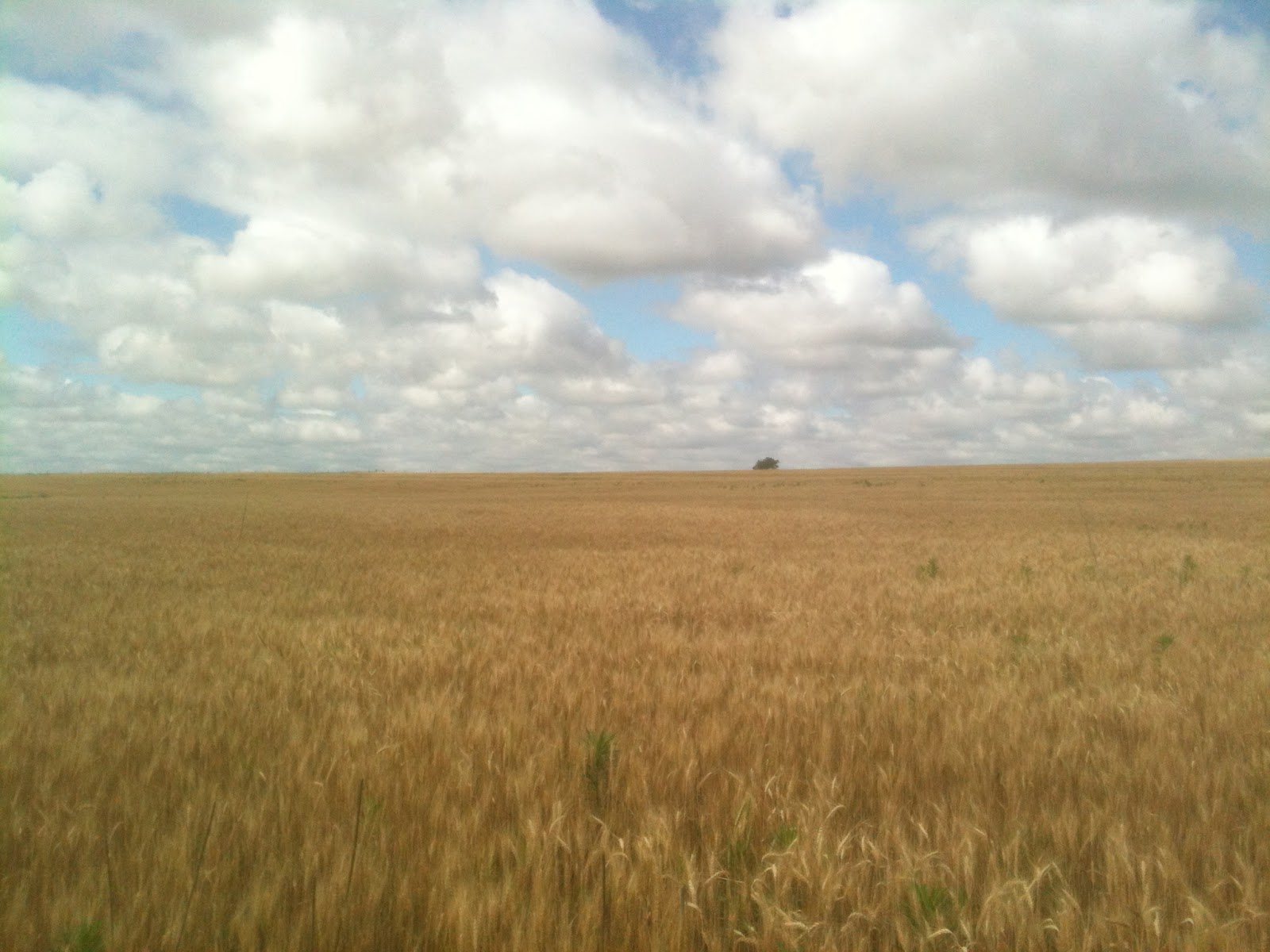
Amber waves of grain with a few weeds scattered here and there
It's amazing how quick everything can dry out around here, less than a week ago it was relatively cool with highs in the 70's, everything was muddy, and I was worrying about making a bunch of horrendous ruts all over the wheat fields trying to harvest the wheat.  

But about a week ago the wind really started blowing, the highs crept up to almost 90, everything is drying out, and I'll probably be cutting wheat in a few days. As much as I pay attention to the weather, it still sort of surprises me how much the weather can change in such a short time and it's one reason I'm always on the lookout for drought conditions to come roaring back even after record-setting amounts of rainfall. 

Right now, even though I'm horrible at predicting wheat yields, I'd predict a below average to average harvest.  It was dry all winter, then we got enough rain to save the crop, followed by almost too much rain at the wrong time to help the wheat but at the right time to get the weeds growing right before harvest when nothing can be done about them, so hoping for an average crop might a little too optimistic. 

It's always better to be a little pessimistic and then surprised when things turn out better than you thought, than to be too optimistic and then really disappointed when things turn out worse than than you hoped for (that's a famous line from one of my many motivational speeches, call for info if you want to book me).

On a more optimistic hopeful note, as soon as wheat harvest is finished, I'm planning on trying a few new things. One new thing I'm going to try is planting a combination cover crop and wildlife food plot strip along one border of the field with a mix of sunflowers, grain sorghum, and whatever else I can find.  Stay tuned for updates on all the dove and quail I'm seeing, the big bucks I see during deer season, and how much the cows like eating sunflowers.

I'm also going to see if I can figure out how to grow double-crop soybeans by planting a 5-acre test field.  The combination of winter wheat and double-cropped soybeans seems like it would be good at both making me some money and building my soils, and it's something I've been considering doing for awhile. Stay tuned for updates about how frustrated I get when all those big bucks eat my soybeans instead of eating the stuff in that food plot on the field border like they're supposed to.

So stay tuned for all that and even more.